
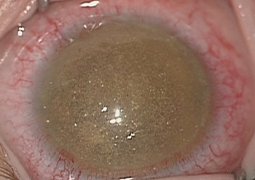


Aim: To present a rare case of anterior chamber cholesterolosis in a patient with Coats’ disease with emphasis on the differential diagnosis, to compare the clinical findings and therapeutic approach with previously reported cases; and to clarify the pathogenetic mechanisms and associated complications of anterior chamber cholesterolosis, based on an analogy with previously published cases.
Case report: A 14-month-old boy was brought to our clinic with a painful, irritated right eye. Anterior chamber cholesterolosis was identified, associated with acute glaucoma, total retinal detachment, and vitreous hyperechogenicity with suspected calcifications on ultrasound (US). Coats’ disease with anterior chamber cholesterolosis or retinoblastoma-associated masquerade syndrome were considered in the differential diagnosis. Magnetic resonance imaging (MRI) did not confirm retinoblastoma. The patient underwent anterior chamber lavage, followed by intracameral and intravitreal injection of an anti-vascular endothelial growth factor (anti-VEGF) agent. A cytological analysis of the anterior chamber aspirate showed no evidence of malignant cells. Although the treatment achieved the expected effect, the eye gradually progressed to phthisis bulbi. Nevertheless, the eye has remained painless, it has shown no signs of irritation and the intraocular condition has remained stable over the long term.
Conclusion: Anterior chamber cholesterolosis is a rare complication of Coats’ disease, reported in less than 3% of patients. Exclusion of retinoblastoma-associated masquerade syndrome is essential in the differential diagnosis. In comparison with previously published cases of anterior chamber cholesterolosis as a complicating factor in Coats’ disease, we have observed a similar character and course of the disease in patients with onset in early childhood. However, a difference can be observed in the therapeutic approach. In all the previously reported cases, the painful eye was enucleated. In our case, preserving the blind eye through a more conservative surgical approach proved beneficial.