
2013 - 1 Issue

Case report

Bilateral Neuroretinitis as an Ocular Manifestation of Cat Scratch Disease in a 9-year-old Boy

Full Text links

Summary

Purpose: 1. To highlight a less-known clinical entity neuroretinitis and the need for differentiation of this entity from the other retinal disease that can mimic. 2. To be familiar with ocular finding in Cat scratch disease.
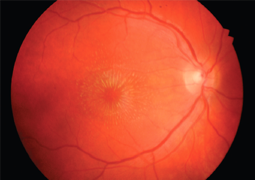
Material and methods: Case report. Authors describe a clinical course of bilateral neuroretinitis in a 9-year-old boy who was referred to our clinic with painless decreased corrected visual aquity in the right eye (6/18) and in the left eye (6/9). Fundus examination disclosed bilateral stellate maculopathy. Patient had a history of close contact with a cat. Serologic tests for infective disease confirmed the presence of IgG antibody against Bartonella henselae (1:64). Specific antibiotic treatment with bacteriostatical activity against Bartonella henselae restored functional and anatomical changes in both of eyes within two month.
Results: Noninfective etiology of bilateral neuroretinitis was essential to exclude in differential diagnosis. Diagnosis of Cat scratch disease was based on positive epidemiological diagnosis, bilateral manifestation of neuroretinitis, high IgG antibody titre against Bartonella henselae and successful treatment of this disease after specific antibiotic therapy.
Conclusion: Neuroretinitis is the most common ocular manifestation of cat scratch disease. Familiarity with differential diagnosis of neuroretinitis is essential for prompt causal treatment initialisation.

References

  1. Baklouti, K., Mghaieth, F., Mhiri, N. et al.: Iridocyclitis in a patient with Behçet‘s disease and a familial form of retinitis pigmentosa. J Fr Ophtalmol. 2007 Oct; 30(8): e25.
  2. Bansal, S., Saha, N., Woon, WH.: The management of „coats‘ response“ in a patient with x-linked retinitis pigmentosa- -a case report. ISRN Surg. 2011; 2011: 970361. Epub 2011 Apr 20.
  3. Barry, MP., Dagnelie, G.: Use of the Argus II Retinal Prosthesis to Improve Visual Guidance of Fine Hand Movements. Invest Ophthalmol Vis Sci. 2012 Jun 1.
  4. Berson, EL., Rosner, B., Sandberg MA. et al.: Further evaluation of docosahexaenoic acid in patients with retinitis pigmentosa receiving vitamin A treatment: subgroup analyses. Arch Ophthalmol. 2004 Sep; 122(9): 1306-1314.
  5. Berson, EL., Rosner, B., Sandberg, MA. et al.: A randomized trial of vitamin A and vitamin E supplementation for retinitis pigmentosa. Arch Ophthalmol. 1993; 111(6): 761–772.
  6. Berson, EL., Rosner, B., Sandberg, MA. et al.: Clinical trial of docosahexaenoic acid in patients with retinitis pigmentosa receiving vitamin A treatment. Arch Ophthalmol. 2004; 122(9): 1297–1305.
  7. Berson, EL., Rosner, B., Sandberg, MA. et al.: Clinical trial of lutein in patients with retinitis pigmentosa receiving vitamin A. Arch Ophthalmol. 2010; 128(4): 403–411.
  8. Besch, D., Sachs, H., Szurman, P., et al.: Extraocular surgery for implantation of an active subretinal visual prosthesis with exernalconnections: feasibility and outcome in seven patients. Br J Ophthalmol. 2008 Oct; 92 (10): 1361–8. Epub 2008 Jul 28.
  9. Hamel, C.: Retinitis pigmentosa, Orphanet J Rare Dis. 2006 Oct 11; 1: 40.
  10. Hamel, CP.: Cone rod dystrophies. Orphanet J Rare Dis. 2007 Feb 1; 2: 7.
  11. Heidemann, DG., Beck, RW.: Retinitis pigmentosa. A mimic of neurologic disease. Surv Ophthalmol. 1987 Jul-Aug; 32(1): 45–51.
  12. Kanski, J. J.: „Clinical Ophthalmology: A Systematic Approach“, Butteworth-Heinemann 2007, s 150–155, ISBN 978070- 2040931.
  13. Kubicka-Trzaska, A., Romanowska-Dixon, B.: Non-malignant uveitis masquerade syndromes. Klin Oczna. 2008; 110 (4–6): 203–6.
  14. Kuchynka, P. et al.: Oãní lékafiství, Grada Publishing, a.s., 2007, s. 279-281, SBN 978-80-247-1163-8.
  15. L I van den Born, M J van Schooneveld, P T de Jong et al.: Fuchs‘ heterochromic uveitis associated with retinitis pigmentosa in a father and son. Br J Ophthalmol. 1994 June; 78(6): 504–505.
  16. Liang, FQ., Aleman, TS., Dejneka, NS., et al.: Long-term protection of retinal structure but not function using RAAV. CNTF in animal models of retinitis pigmentosa. Mol Ther. 2001 Nov; 4(5): 461–72.
  17. Lichtinger, A., Chowers, I., Amer, R.: Usher syndrome associated with Fuchs‘ heterochromic uveitis. Graefes Arch Clin Exp Ophthalmol. 2010 Oct; 248(10): 1481–5. Epub 2010 Jun 24.
  18. Marmor, MF.: A randomized trial of vitamin A and vitamin E supplementation for retinitis pigmentosa [reply letter]. Arch Ophthalmol. 1993; 111(11): 1460–1461.
  19. Musarella, A. M., MacDonald, I. M.: Current Concepts in the Treatment of Retinitis Pigmentosa. J Ophthalmol. 2011; 2011: 753547. Epub 2010 Oct 11.
  20. Nagpal, A., Biswas J.: Pseudouveitis - analysis of cases misdiagnosed as posterior uveitis. Ocul Immunol Inflamm. 2006 Feb; 14(1): 13–20.
  21. Norton, EWD.: A randomized trial of vitamin A and vitamin E supplementation for retinitis pigmentosa [letter to the editor]. Arch Ophthalmol. 1993;111(11): 1460.
  22. Nussenblatt, R.B., Whitcup, S.M., Palestine, A.G.: Masquerade syndromes. In: Uveitis: Fundamentals and clinical practice. Mosby-Year Book, Inc., St. Louis, 1996: 385–395.
  23. Otradovec, J.: Klinická neurooftalmologie, Grada Publishing, a.s., 2003, s. 159-164, ISBN: 80-247-0280-0.
  24. Říhová, E. et al.: Uveitidy, Grada Publishing, a.s., 2009, s. 102-105, ISBN 978- 80-247-2897-1.
  25. Tan, MH., Smith, AJ., Pawlyk, B. et al.: Gene therapy for retinitis pigmentosa and Leber congenital amaurosis caused by defects in AIPL1: Effective rescue of mouse models of partial and complete Aipl1 deficiency using AAV2/2 and AAV2/8 vectors. Hum Mol Genet. 2009 Jun 15; 18 (12): 2099-
  26. Willermain, F., Greiner, K., Forrester, JV.: Atypical end-stage birdshot retinochoroidopathy. Ocul Immunol Inflamm. 2003 Dec; 11(4): 305–7.
  27. Epud 2009 Mar 19.