
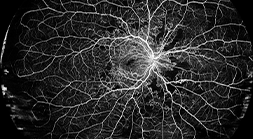

Ultra-widefield optical coherence tomography angiography represents the latest technological advance that significantly expands the possibilities of non-invasive imaging, not only of retinal and choroidal microcirculation. Compared to conventional OCTA, it enables visualization of the peripheral retina, providing a more comprehensive view of the distribution of vascular changes across a wide spectrum of diseases. In clinical practice, this technology may reduce the need for invasive examinations, particularly fluorescein angiography, or contribute to more accurate identification of patients in whom such examination remains necessary.
The aim of this paper is to highlight the clinical application of UWF-OCTA in everyday practice and to demonstrate its benefits based on original imaging material. The study presents typical findings in diabetic retinopathy, central serous chorioretinopathy, pediatric retinal vascular diseases, and vitreoretinal pathologies.
- Ultra-widefield OCTA in Clinical Practice: Expanding Insights into the Peripheral Retina. A Review
- The Role of Prophylactic Topical Administration of Antibiotics in Uncomplicated Cataract Surgery in the Era of Intracameral Antibiotics
- Retinal Nerve Fiber Layer and Ganglion Cell Complex Thickness Analysis in Treatment – Naive Glaucoma Patients
- Customized Cryotherapy for Ocular Salvage in Descemetocele and Iris Prolapse: A 17-Year Retrospective Study
- Evaluation of the Effects of Intravitreal Application of an Ozurdex Implant in Patients with Macular Edema due to Retinal Vein Occlusion
- Hyperreflective Outer Nuclear Layer as a Biomarker of Early Stargardt Disease. A Case Report