
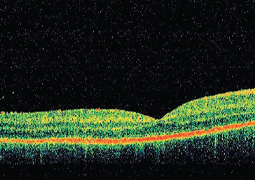

Vogt-Koyanagi-Harada (VKH) syndrome is a multisystemic disease characterized by granulomatous panuveitis with exsudative retinal detachment and often associated with neurological and skin symptomatology.
In the paper is presented a rare case of probably VHK syndrome in 11-year old caucasian race boy in which was found the bilateral granulomatous panuveitis with exsudative retinal detachment without other systemic symptomatology with typical clinical characteristics and course. Systemic corticosteroid therapy in a patient gradually improved the state, which was then complicated by the occurrence of juxtapapillary subretinal neovascular membrane on both eyes. The following administration of intravitreal injection anti-VEGF (bevacizumab) was modified visual acuity and reduced neovascular membrane.
- Screening ROP in the University Hospital Ostrava
- New Possibilities for Screening of Refractive Errors among Children
- The Importance of Angle Kappa for Centration of Multifocal Intraocular Lenses
- Myopia or Hypermetropia?
- HDR 192Ir Brachytherapy in Treatment of Basal Cell Carcinoma of the Lower Eyelid and Inner Angle – Our Experience
- Contraception and Ocular Thromboembolic Episodes
- Vogt-Koyanagi-Harada Syndrome in Children